


Views: 0 Author: Site Editor Publish Time: 2026-09-15 Origin: Site


Fastening structural elements to a concrete slab often feels like a straightforward task. You drill a hole, insert the fastener, and apply torque. However, specifying an anchor without verifying the concrete’s compressive strength (PSI or MPa) leads to dangerous outcomes. You risk catastrophic joint failure if the substrate is too weak. Conversely, you waste budget on unnecessary over-engineering if you misjudge the base material. An anchor’s published ultimate load is only valid if the base material can actually withstand the transferred forces. Ultimately, concrete strength dictates whether the system fails at the fastener or within the substrate. This article provides engineers, contractors, and procurement teams a clear framework for evaluating how concrete PSI impacts load capacities. You will learn how to accurately select between mechanical and chemical fastening systems to ensure structural safety.
Substrate acts as the ceiling: A high-tensile steel fastener cannot achieve its maximum load capacity in low-strength concrete; the concrete will fracture first.
Anchor type matters: Chemical adhesives generally outperform mechanical friction in lower-PSI or aging concrete by distributing stress more evenly.
Variables compound: Compressive strength must be calculated alongside embedment depth, edge distance, and spacing to determine allowable loads.
Compliance is non-negotiable: Accurate specification requires cross-referencing concrete grade with ICC-ES or ETA technical data sheets.
Understanding load capacity requires looking beneath the surface. When you install a concrete anchor bolt, it acts as a mechanical bridge. It transfers tensile loads (pulling forces) and shear loads (perpendicular forces) directly into the surrounding base material. The concrete absorbs these forces and disperses them. The structural integrity of the entire connection depends on this dispersion.
Compressive strength serves as your fundamental baseline. We measure this in pounds per square inch (PSI) or megapascals (MPa). Higher compressive strength directly increases the concrete's resistance to local crushing. It also prevents premature cone breakout during heavy loading. A 5,000 PSI concrete slab offers significantly more resistance than a 2,500 PSI slab. The denser the concrete, the better it grips the fastener.
Engineers always apply the "weakest link" principle in structural design. The overall connection capacity is determined by the weakest component in the assembly. This will be either the steel bolt itself or the concrete substrate. If you embed a high-strength carbon steel bolt into low-strength concrete, the steel strength becomes irrelevant. The concrete will fracture long before the steel ever yields. You must balance the fastener’s tensile strength against the substrate’s compressive capabilities to avoid sudden failures.
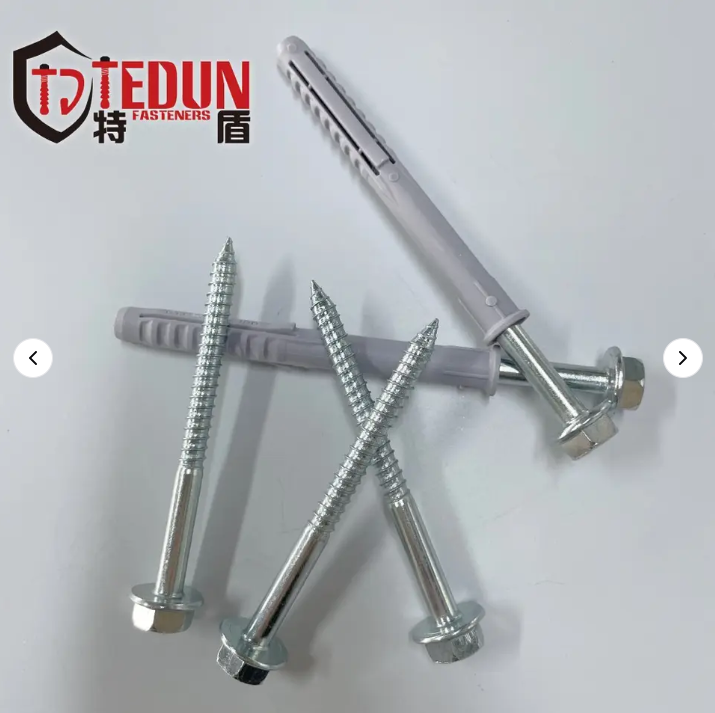
Different fastening systems interact with concrete in very different ways. You must match the fastener type to the actual condition of your substrate.
These traditional systems rely entirely on friction and expansion forces. You apply torque to a mechanical anchor bolt to expand its base. This expansion presses hard against the walls of the drilled hole. Because of this aggressive action, the performance profile is rigid. This system requires solid, predictable, high-strength concrete. If the concrete is weak or porous, the substrate will crack locally during torque application. You will strip the hole before achieving the required holding power.
These fasteners are a specific subset of mechanical systems. A wedge anchor bolt provides immense heavy-duty holding power. As you tighten the nut, it pulls a cone-shaped stud up through an expansion clip. This generates massive concentrated stress at a single point inside the hole. This introduces a major risk factor. You face a high risk of substrate failure, such as spalling or blowout. You should never use these in green, lightweight, or low-PSI concrete.
Adhesive systems take a fundamentally different approach. A chemical anchor bolt bonds along the entire embedment depth. The two-part epoxy or resin cures and micro-keys into the concrete pores. This creates zero expansion stress upon installation. This lack of stress provides a huge strategic advantage. It is the preferred solution for low-PSI, aging, or unknown concrete strengths. It relies entirely on chemical adhesion rather than mechanical wedging.
Table 1: Anchor Category Comparison Matrix
Anchor Category | Primary Load Transfer | Concrete Strength Requirement | Expansion Stress Level |
|---|---|---|---|
Mechanical | Friction / Expansion | Medium to High PSI | High |
Wedge | Point-concentrated Wedging | High PSI (Uncracked) | Very High |
Chemical | Full-depth Adhesion | Low to High PSI | Zero |
When you overestimate concrete strength, the fastening system will fail. You must recognize these failure modes to diagnose structural issues correctly on the job site.
This remains the most common failure mode. It happens when concrete strength proves insufficient for the applied tensile load. The concrete literally tears apart. It fractures in a distinct cone shape radiating upward from the embedded end of the anchor. The volume of this breakout cone dictates the maximum tensile load the substrate can handle. Weak concrete produces a smaller stress cone, leading to early failure.
Pull-out occurs when the anchor slides out of the hole intact. The friction mechanism or the chemical bond becomes completely compromised. Weak concrete aggregate often causes this issue. The internal walls of the hole crumble under pressure. Improper hole cleaning also triggers slip failures. Leaving drilling dust inside the hole acts as a lubricant. It prevents the adhesive from bonding directly to the concrete pores.
Edge breakout is a severe shear failure. It occurs when you place anchors too close to the slab edge. When you apply shear loads (sideways force), the concrete lacks the density to resist the outward pressure. The edge of the slab simply blows out. Lower PSI concrete requires much larger edge distances to prevent this failure.
Best Practices to Prevent Early Failure:
Always blow out the drilled hole with compressed air at least twice.
Use a stiff wire brush to scrub the hole walls before applying chemical adhesives.
Verify the concrete has cured for a minimum of 28 days before installing mechanical fasteners.
Avoid placing heavy-duty expansion fasteners in unreinforced slab edges.
Theoretical lab data provides a starting point. However, implementation realities often force engineers and contractors to adjust their calculations. You must account for several physical variables to avoid relying purely on published maximum loads.
Embedment depth represents how far the fastener penetrates the concrete. Deeper embedment exponentially increases the volume of the concrete stress cone. A larger cone means the anchor recruits more surrounding concrete to resist pull-out forces. Increasing the embedment depth is the most effective way to compensate for lower PSI concrete. It provides a larger surface area for both mechanical grip and chemical adhesion.
You rarely install just one fastener. You usually install multiple units in a group. When you place anchors in close proximity, their internal stress cones begin to overlap. This overlapping effect reduces individual load capacities. The concrete cannot support double the stress in the shared area. You must strictly adhere to ACI 318 reduction factors to calculate the true capacity of the entire group.
Concrete strength strictly dictates the minimum allowable distance from the slab edge. Moving the fastener further inland prevents shear blowouts. Weak concrete requires a massive edge distance to safely distribute outward shear forces. If you must install near an edge, you usually have to abandon expansion fasteners altogether. You must pivot to adhesive solutions to avoid pre-stressing the fragile edge.
Chart: Impact of Installation Variables on Load Capacity
Variable Adjustments | Impact on Stress Cone | Net Effect on Allowable Load |
|---|---|---|
Increasing Embedment Depth | Expands cone volume | Significantly increases capacity |
Decreasing Anchor Spacing | Creates overlapping cones | Requires severe load reduction |
Decreasing Edge Distance | Truncates the stress cone | Reduces shear and tensile capacity |
Accurate specification prevents structural disasters. Follow this four-step framework to ensure you select the appropriate fastener for your specific concrete conditions.
Step 1: Audit the Base Material. Start by determining the concrete type. Identify if it is normal weight or lightweight concrete. Test or verify its exact compressive strength (PSI). Finally, inspect the condition to see if the slab is cracked or uncracked. Cracked concrete requires specialized fasteners certified for those exact conditions.
Step 2: Match Anchor Type to Stress Tolerance. Once you know the concrete condition, choose your system. Use heavy mechanical options for pristine, high-PSI substrates. Pivot immediately to chemical or epoxy systems for fragile, low-PSI, or severely cracked concrete. Never force an expansion fastener into a brittle base.
Step 3: Apply Safety and Reduction Factors. You cannot use the ultimate load listed on the box. Consult the manufacturer Technical Data Sheets (TDS) or ICC-ES reports. You must apply reduction factors for environmental conditions, spacing overlaps, and edge distance limits. These calculations determine the actual safe allowable load.
Step 4: Real-World Validation. We strongly recommend on-site pull-testing. Conduct these tests for any critical load applications. You must also perform pull-tests when the base material strength remains completely undocumented. A hydraulic pull-tester will prove exactly what the substrate can handle before failure occurs.
The holding power of any structural fastening system is fundamentally capped by the structural integrity of the concrete it sits in. You cannot solve a weak concrete problem simply by buying a stronger steel bolt. To ensure structural safety and avoid over-engineering costs, follow these final action steps:
Move beyond generic product labels and evaluate the actual concrete environment first.
Consult manufacturer engineering tables and ICC-ES reports to verify substrate compatibility.
Always calculate site-specific reduction factors for edge distance and anchor spacing.
Enforce strict hole-cleaning protocols on the job site to maximize bond strength.
Contact technical support teams for custom load calculations when dealing with undocumented concrete.
A: Not always. While a larger bolt increases steel strength and surface area, it requires a larger hole and deeper embedment. If the concrete is brittle, a larger mechanical anchor may actually induce cracking during installation. Chemical adhesives are a better solution for weak substrates.
A: Green concrete retains high moisture and has not reached its 28-day design strength. Most mechanical and chemical anchors require fully cured concrete (usually 21-28 days) unless the manufacturer explicitly holds an ICC-ES report for green concrete applications. Moisture can destroy the chemical bond.
A: Most manufacturers base their baseline load tables on 2,000 PSI (13.8 MPa) to 4,000 PSI normal-weight concrete. Anything below 2,000 PSI generally requires specialized chemical anchoring or through-bolting to prevent the substrate from spalling under expansion pressure.