


Views: 0 Author: Site Editor Publish Time: 2026-05-08 Origin: Site


When structural hardware fails, the destruction rarely stops at a simple broken fixture. Equipment collapses, severe safety hazards, and immediate compliance violations often follow instantly. These risks carry massive operational and financial penalties. The fundamental reality is simple. An anchor is only as strong as the concrete holding it. Selecting the proper fastener requires you to carefully evaluate the base material, specific load vectors, and harsh environmental conditions. Simply picking the largest piece of metal available invites catastrophic structural failure. It places your entire project at risk. This guide provides a transparent, engineering-based framework for evaluating industrial fasteners. You will learn how to accurately calculate load requirements, assess environmental constraints, and confidently shortlist the correct Anchor Bolt for specific commercial, industrial, or heavy-duty applications.
Rule of Thumb for Safety: Never exceed the recommended Safe Working Load (SWL), which is typically 25% of the anchor’s ultimate failure capacity (a 4:1 safety factor).
Concrete Readiness: Concrete must cure for a minimum of 28 days before installing expansion or mechanical anchor bolts.
Load Direction Matters: Fastener selection changes drastically depending on whether the application involves Tension (pull-out force, e.g., ceilings) or Shear (downward force, e.g., walls).
Match Anchor to Base: Heavy-duty wedge and drop-in anchors are strictly for solid concrete; hollow blocks or brick require sleeve or specialized masonry anchors.
Every successful installation begins by understanding the exact material receiving the fastener. The substrate determines your entire selection process. It dictates the holding power, the expansion mechanism, and the ultimate longevity of the connection.
Concrete compressive strength directly controls how well a mechanical lock functions. Standard concrete generally falls under 7,000 PSI. High-strength concrete ranges from 7,000 to 14,500 PSI. Higher PSI ratings provide significantly stronger friction against expansion clips. Lower PSI ratings require specialized fasteners to prevent material blowout. You must know your concrete's rating before buying hardware.
Implementation Risk: Installing fasteners into "green concrete" creates severe hazards. Concrete must cure for at least 28 days. Concrete younger than 28 days remains soft. It will fail to hold expansion forces properly. The anchor will simply carve out the hole and slip under load.
Not all masonry behaves the same way under internal pressure. Your base material dictates the fastener geometry. Use the following matrix to guide your base material matching.
Base Material Type | Characteristics | Ideal Fastener Styles |
|---|---|---|
Solid Concrete | Dense, uniform structure. High compressive strength. Can handle extreme localized expansion forces. | Wedge Anchors, Drop-In Anchors, Heavy-Duty Threaded Rods. |
Hollow Block / Brick | Brittle walls, hollow voids, lower compressive strength. Prone to cracking under pinpoint pressure. | Sleeve Anchors, Chemical/Adhesive Anchors, Specialized Masonry Screws. |
Mortar Joints | Very soft. Crumbles easily under vibration or expansion. | Avoid anchoring directly into mortar. Relocate hole to solid brick or block face. |
Solid concrete perfectly supports wedge and drop-in designs. These heavily rely on extreme pinpoint friction. Conversely, hollow block, brick, and mortar require sleeve anchors. Sleeve anchors distribute expansion pressure across a wider surface area. Alternatively, you might use chemical anchoring systems. These adhesives bond to brittle walls without relying on outward mechanical pressure.
Environmental conditions destroy unprotected steel rapidly. You must match the metal alloy to the specific environment.
Dry/Indoor Environments: Standard zinc-plated carbon steel works perfectly here. It provides basic oxidation resistance. It remains cost-effective for climate-controlled interiors.
Outdoor/Wet Environments: Hot-dipped galvanized (HDG) steel offers thicker protection. The zinc coating delays rust significantly. However, it will eventually corrode over decades of moisture exposure.
Submerged/Chemical Exposure: Harsh environments demand 304 or 316 Stainless Steel. Coastal projects, chemical plants, and underwater applications require this upgrade. Stainless steel is mandatory to pass standard ASTM B117 salt spray testing.
Common Mistake: Never mix stainless steel fasteners and carbon steel fixtures in wet environments. Galvanic corrosion will rapidly degrade the less noble metal.
Evaluating weight alone is never enough. You must understand how weight pulls against the specific installation angle. Directional force changes the failure physics entirely.
Different mounting angles introduce completely different stresses. We divide these primarily into tension and shear forces.
Tension (Pull-out force): This occurs during overhead installations. Gravity pulls the fixture straight down, away from the concrete. Ceiling-mounted pipes or suspended HVAC units create pure tension. Overhead tension relies heavily on deep embedment depth. The deeper the fastener sits, the more concrete it grabs.
Shear (90-degree force): Wall-mounted fixtures face shear stress. Gravity pulls the fixture downward parallel to the wall face. It tries to slice the steel bolt in half. Shear capacity depends heavily on the fastener's exact steel diameter. Extended embedment depth adds very little shear strength. Thick steel prevents slicing.
Manufacturers list ultimate load testing data on their specification sheets. This ultimate load defines the exact point of catastrophic failure. You must never use this number for everyday design.
We instruct buyers to read manufacturer specification sheets critically. You must divide the ultimate failure data by 4. This simple math determines the safe working load (SWL) limit for standard static loads. For example, a fastener rated for 4,000 lbs ultimate tension holds a safe working load of 1,000 lbs. Adhering to this 4:1 safety factor ensures structural integrity over decades of use.
Static loads sit perfectly still. Dynamic loads move, vibrate, and shake. Equipment like industrial generators, heavy machinery, or stamping presses introduces severe dynamic forces.
Standard wedge anchors often loosen under constant severe vibration. The continuous shaking walks the expansion clip backward. For heavy vibration environments, engineers often specify heavy-duty sleeve fasteners or chemical adhesives. Chemical adhesives lock the threaded rod permanently into the substrate. They absorb shock loads far better than mechanical friction clips. Always evaluate dynamic vibration before finalizing your hardware selection.
Fasteners fall into specific duty ratings. Choosing the right category ensures safe performance without over-engineering your budget. Let us explore the three primary classifications based on load demands.
Major structural connections demand uncompromising strength. These fasteners secure steel columns, heavy machinery, and critical safety infrastructure.
Wedge Anchors: These are best for solid concrete. They provide the highest overall load capacity. They offer a unique installation advantage. They allow for leveling and shimming the fixture during the actual installation process. You insert them through the fixture directly into the hole.
Drop-In Anchors: These flush-mount fasteners feature internal threading. You set them permanently into the substrate. They are ideal for overhead structural arrays. They provide perfect permanent anchoring points. You can easily remove and re-insert the threaded bolts without losing the anchor base.
Medium-duty hardware secures electrical panels, heavy shelving, and handrails. They require strong holding power but face less catastrophic stress.
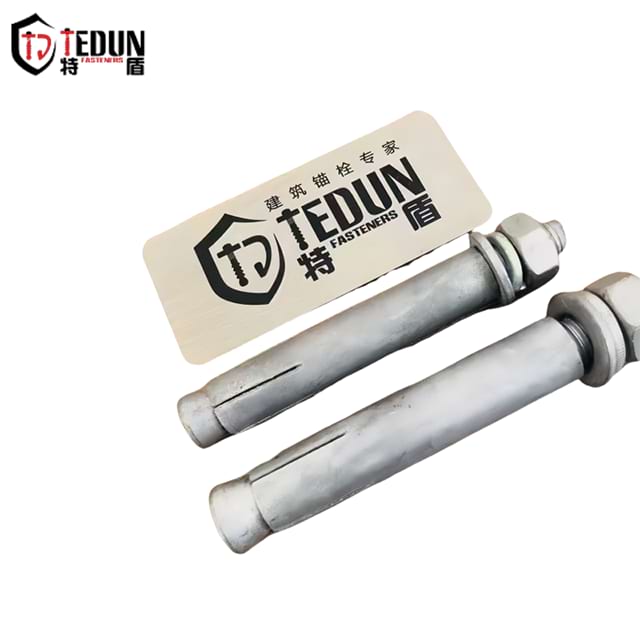
Sleeve Anchors: These are incredibly versatile. The outer metal sleeve expands along the entire length of the internal bolt. This disperses weight widely. It makes them perfectly safe for brittle brick, hollow block, and older, softer concrete.
Strike Anchors: These provide very fast installation. You simply strike the central pin to expand the base. They handle medium loads efficiently. However, they are strictly non-removable.
Light fixtures, small signage, and basic conduit framing require minimal holding power. Do not overcomplicate these installations.
Concrete Screws: These thread directly into a pre-drilled hole. They cut their own grooves. They install quickly and remove easily.
Plastic/Nylon Expansion Anchors: These utilize simple plastic ribbed bodies. You drive a basic screw inside to expand them. They hold lightweight frames and small junction boxes.
Best Practice: We strongly advise against using any light-duty plastic or nylon fasteners for structural framing or life-safety applications. They melt during fires and degrade rapidly under heavy tension.
Duty Rating | Weight Range | Optimal Fastener Types | Common Applications |
|---|---|---|---|
Heavy-Duty | 500+ lbs | Wedge, Drop-In, Chemical | Structural columns, heavy machinery, overhead arrays. |
Medium-Duty | 100 - 500 lbs | Sleeve, Strike | Handrails, electrical panels, industrial shelving. |
Light-Duty | Under 100 lbs | Concrete Screws, Plastic Expansion | Signage, conduit clips, lightweight frames. |
Procuring reliable hardware requires strict adherence to industry building codes. The sourcing process carries immense legal and structural liability. You must evaluate the creator of your hardware carefully.
Heavy commercial applications require hardware meeting strict structural codes. Building inspectors look for compliance alongside the 2015 International Building Code (IBC) and ACI 318 standards. You cannot simply install unchecked steel.
You must specifically look for ICC-ES evaluation reports. These reports test products against cracked and uncracked concrete conditions. They also evaluate performance across seismic design categories (A-F). Products carrying these certifications prove their reliability under extreme, unpredictable stresses. Inspectors routinely reject uncertified hardware on commercial job sites.
Supply chain transparency protects your project. Partnering with an established Anchor Bolt manufacturer ensures complete traceability of steel grades. Quality manufacturers deliver consistent thread rolling and precise metallurgical tempering. They also grant you direct access to verified engineering load tables.
Many contractors attempt to save budget dollars using cheap, uncertified imports. These untested products introduce incalculable liability risks. Cheap steel shears unpredictably under shear loads. Inconsistent threads strip under torque wrench tightening. When structural failure occurs, uncertified hardware leaves you entirely liable. Investing in reputable, traceable manufacturing protects your budget, your timeline, and human lives.
Even the finest hardware fails if installed poorly. Field execution matters just as much as engineering calculations. Follow these critical installation realities to secure your fixtures properly.
Drilling exact depths sounds logical, but it causes frequent failures. Always drill the hole at least 1/2 inch deeper than the planned embedment depth. This extra space creates a necessary reservoir. It holds residual concrete dust. You can never entirely remove all powder from a deep hole. Without this reservoir, the hardware bottoms out early. It hits compacted dust before reaching the proper depth.
Mechanical expansion relies heavily on abrasive friction. Clean holes provide maximum grip. Failing to blow out concrete dust ruins this friction entirely.
Trapped dust acts as a high-performance lubricant. It coats the hole walls. When you expand the clip, it slides against the powder instead of biting the solid wall. This severely degrades ultimate pull-out resistance. Always use a specialized wire brush. Follow up immediately using a high-powered vacuum or compressed air. Blow the hole clean completely before inserting any steel.
Precision tooling prevents substrate damage. Always use a dedicated rotary hammer drill. Pair it with an ANSI-standard carbide bit matched exactly to the fastener's diameter. Worn bits drill undersized holes, preventing insertion. Cheap bits drill oversized, wobbly holes, ruining friction capacity.
Finally, utilize proper torque wrench tightening. You must tighten the nut to exact manufacturer specifications. Usually, this requires 3 to 5 full turns past finger-tight for standard wedge applications. Guessing the torque invites disaster. Under-tightening leaves the expansion clip unengaged. Over-tightening snaps the steel head right off the shaft. Use a calibrated torque wrench every single time.
Selecting reliable structural hardware does not need to involve guesswork. By evaluating the foundational elements of your project, you ensure safety and compliance. We recommend finalizing your hardware choices using a simple, three-step shortlisting logic.
First, identify your base material clearly. Separate solid matrices from hollow or brittle walls. Second, calculate your maximum dynamic and static loads carefully. Always apply the strict 4:1 safety ratio. Third, determine the exact environmental exposure. Choose zinc for dry interiors or stainless steel for corrosive environments.
Your next step requires decisive action. We strongly advise you to consult licensed structural engineers for all critical, life-safety applications. Furthermore, request comprehensive spec sheets and verified testing data directly from your manufacturer before authorizing bulk procurement. Diligent preparation guarantees structural success.
A: No. Wedge anchors are permanent. Once the expansion clip engages deep inside the concrete, you cannot reverse it. If removal is absolutely necessary, the bolt must be sawed off flush with the concrete surface. If your application requires future reusability, you should specify a Drop-In anchor instead.
A: Generally, structural anchors require a minimum edge distance of 5 anchor diameters. This critical distance prevents dangerous "blowout" or severe cracking of the concrete corner. However, this rule varies slightly depending on specific manufacturer engineering specs and the exact concrete PSI.
A: Stop drilling immediately. Pushing through damages both your drill bit and the structural rebar. Relocate the hole if allowable by the fixture design. If relocation is impossible, switch to an alternative fastening method, such as epoxy or chemical adhesives, assuming a structural engineer approves the change.