


Views: 0 Author: Site Editor Publish Time: 2026-05-11 Origin: Site


Securing structural elements to concrete requires bridging the gap between theoretical load capacities and harsh field realities. Improper specification leads to catastrophic failure. We have seen this clearly in historical infrastructure collapses. For engineers, contractors, and procurement teams, selecting the right chemical adhesive involves much more than reviewing raw pull-out strength. You must actively evaluate creep resistance, environmental compatibility, and strict installation tolerances.
This guide provides a compliance-aware framework for evaluating, specifying, and implementing concrete anchoring adhesives. We built this guide to help you secure high-stakes structural framework effectively. It specifically addresses heavy support configurations like structural steel framing. You will learn how to navigate allowable load metrics, adapt to environmental variables, and enforce non-negotiable field installation standards to guarantee structural integrity.
Performance Thresholds: Allowable load capacities for anchoring adhesives generally require a 75% reduction (a 25% safety factor) from the ultimate tensile strength.
Application Specifics: Adhesive anchors excel in cracked concrete and vibration-prone environments compared to mechanical anchors, provided installation temperatures meet baseline requirements (typically >50°F / 10°C).
Installation Rigor: Up to 90% of adhesive anchor failures stem from improper hole preparation. Standardized "Blow-Brush-Blow" protocols using 90-psi compressed air are non-negotiable.
Structural Pairing: When fastening heavy support structures, precise alignment between the anchor spacing and the mounting dimensions of the C channel steel is required to prevent overlapping stress cones.
You must establish a strong technical baseline before specifying adhesives over traditional mechanical expansion anchors. They function through entirely different physical mechanisms. Understanding these mechanics ensures you select the safest fixation path for your structural loads.
Adhesives bond along the entire embedded length of the threaded rod. They effectively eliminate the concentrated point-stress caused by mechanical wedge anchors. When you install a mechanical anchor, it expands and exerts immense active force against the concrete. Over time, this localized stress can cause micro-cracking in weaker base materials. Chemical adhesives avoid this. They distribute the tensile load evenly across the full surface area of the drilled hole. This creates a monolithic bond between the concrete and the steel rod.
Adhesives permit much closer center-to-center spacing. They also allow for narrower edge margins. Because they do not exert active expansion forces on the base material, you can place them nearer to the edge of a concrete slab without risking edge blowout. This flexibility proves essential when designing dense mounting baseplates for structural framework.
Chemical anchors provide superior resistance to cyclical loading and vibration. Mechanical anchors often loosen over time when subjected to constant shaking. Therefore, adhesives are ideal for securing heavy machinery or heavy-duty structural steel frameworks. The cured polymer absorbs micro-vibrations, maintaining the integrity of the joint.
Despite their strength, adhesives come with specific operational limitations. They require precise curing times before bearing loads. You cannot load them immediately like mechanical anchors. Furthermore, they are highly sensitive to expiration dates. You must also maintain strict temperature controls during installation. If the ambient temperature falls below the manufacturer's baseline, the chemical reaction slows significantly or halts altogether.
Feature | Adhesive Anchors | Mechanical Anchors |
|---|---|---|
Load Distribution | Full embedded length | Concentrated point-stress |
Edge Distance Flexibility | High (closer to edges) | Low (requires wider margins) |
Dynamic Load Resistance | Excellent | Poor to Moderate |
Immediate Loading | No (requires curing time) | Yes |
You cannot treat all anchoring adhesives identically. Formulations vary drastically between epoxy and acrylic blends. You must evaluate these products against your specific project conditions to prevent systemic failure.
Standard compliance frameworks, such as ACI 318, dictate how engineers evaluate adhesives. You must evaluate them specifically for their performance in cracked concrete. Cracked concrete significantly reduces the tensile breakout capacity of the anchor. As loads shift and structures settle, hairline cracks naturally form in the tension zones of concrete elements. Your chosen adhesive must carry certifications proving it can bridge these cracks and maintain its holding power.
Working Time Evaluation: Evaluate the adhesive's working time against ambient site temperatures. Gel time determines how long your crew has to insert the threaded rod before the chemical begins to harden. Hotter temperatures drastically reduce gel time.
Moisture State Matching: Formulations must match the moisture state of the hole. You require specific acrylic or epoxy blends for water-filled or submerged holes. Submerged environments necessitate specialized flushing procedures rather than standard air-blowing. If you use a standard dry-hole epoxy in a water-filled cavity, the resin will fail to bond with the concrete pores.
Never design your support structure to the ultimate pull-out strength. Ultimate strength merely represents the extreme force required to catastrophically break the anchor in a controlled laboratory setting. Instead, apply mandatory safety factors to calculate the realistic allowable load. Frequently, engineers use 25% of the ultimate pull-out strength as the baseline for everyday operation. This massive buffer accounts for unseen variables in base material quality and field installation inconsistencies.
Integrating chemical anchors with heavy metal framing requires specific engineering considerations. We often encounter complex force dynamics when anchoring common structural profiles. You must approach these installations systematically.
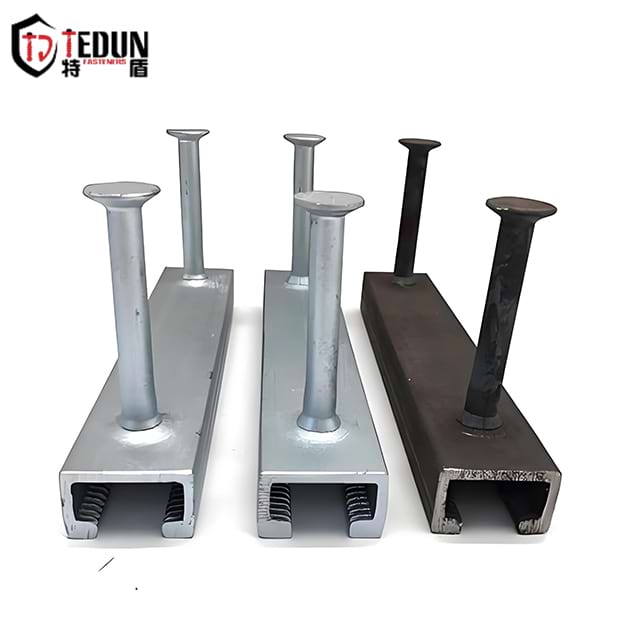
When mounting structural framework like C Channel Steel to concrete walls or floors, the anchors face intense multidirectional forces. They simultaneously face tensile pull-out forces and downward shear forces. The weight of the steel pulls outward, while gravity pulls downward. Evaluators must verify the combined load equation to ensure the joint holds. Engineers typically use an interaction formula. The combined ratio of applied tension to allowable tension, plus applied shear to allowable shear, must remain within safe design limits.
Specifying high-grade adhesive is obsolete if the structural steel yields under pressure. You must pair top-tier chemicals with robust steel elements. Sourcing pre-punched or custom-slotted framework from a reputable C Channel Steel manufacturer ensures your anchor placement aligns precisely with engineering drawings. If the slots do not align, contractors may drill field holes improperly. This compromises the integrity of the baseplate and shifts unexpected loads onto individual anchors.
Fastening C channel often requires grouping anchors closely together. Evaluators must carefully account for spacing reductions. As an anchor bears load, it projects a stress cone into the surrounding concrete. If anchors sit too close together, their failure stress cones overlap. This overlapping drastically reduces the total holding capacity of the joint. You must space the anchors far enough apart so each one can leverage its own independent volume of concrete. If spacing must remain tight due to design constraints, you must apply heavy reduction factors to your load calculations.
Transparently addressing how and why adhesive systems fail demonstrates true structural expertise. Recognizing early warning signs prevents minor issues from escalating into major collapses.
Concrete breakout remains the most common structural failure mode. Under extreme tension, a conical chunk of concrete pulls away entirely from the base material. Under shear stress, edge breaks occur when the anchor forcefully pushes outward toward the nearest free edge of the slab. You prevent this by strictly observing minimum embedment depths and edge distance guidelines. Thicker base materials and deeper embedment help push the potential failure plane deeper into stronger concrete.
Bond failure occurs directly at the interface between the concrete and the adhesive, or between the adhesive and the steel rod. The threaded rod simply slips out, often leaving a smooth layer of cured epoxy behind. This is almost universally a symptom of inadequate hole cleaning. Retained dust acts as a barrier. It prevents the polymer from soaking into the microscopic pores of the concrete. Proper cleaning protocols eliminate this risk.
Chemical adhesives are highly susceptible to microscopic deformation over time. This happens under continuous heavy loads, particularly in elevated temperatures. This phenomenon is known as creep. Evaluators must restrict long-term continuous loads to specific standard thresholds. Industry codes often limit sustained loads on chemical anchors to a fraction of their baseline capacity to prevent slow, unnoticed pullout over decades of service.
Pryout represents a localized shear failure mode. It primarily affects short, stiff anchors. When extreme shear force hits the top of the anchor, the bottom of the embedded rod acts like a lever. This base movement fractures the concrete behind the direction of the applied load. Increasing embedment depth usually neutralizes pryout risks.
Translating product capabilities into flawless field execution guarantees safety. You must implement rigid Standard Operating Procedures (SOPs) for your crews. Even the strongest adhesive fails if installed carelessly.
Hole preparation dictates the success of your installation. You must follow the Blow-Brush-Blow mandate meticulously.
First Blow: Blow out dust using compressed air. The compressor must deliver a minimum of 90 psi. Blow air from the back of the hole outward for 2–4 seconds.
Brush Cycle: Cycle a specialized steel or nylon brush into the hole 2–4 times. This scrubs caked dust from the side walls.
Final Blow: Perform a secondary 90-psi blowout. This ensures zero residual dust remains in the cavity.
Installing anchors horizontally or overhead introduces new challenges. Overhead and horizontal installations heavily risk air voids inside the adhesive. You must mandate the use of piston plugs and extension tubes. These tools inject adhesive directly from the back of the hole outward. The back-pressure pushes the piston plug out slowly, preventing trapped air pockets.
Hollow base materials, such as unreinforced brick or hollow block, require specialized screen tubes. These mesh tubes contain the adhesive. As you inject the chemical, it extrudes slightly through the screen, creating a physical "keying" interlock inside the hollow cavity.
You must define clear post-installation verification protocols. Implement Proof Testing on a sampling of your installations. This involves stressing anchors to 125% of the steel's yield strength. The anchor must sustain this force without exceeding 1/16-inch of slippage. Alternatively, perform routine Field Testing at 90% of the yield strength. These objective field tests guarantee system integrity before workers attach heavy structural steel components.
Concrete anchoring adhesive operates as a highly engineered structural component, not a cheap commodity. The success of your structural joints hinges on matching the exact chemical formulation to the base material condition. You must understand long-term load behaviors, especially the complex tension and shear interactions found on heavy steel frameworks. Above all, you must enforce merciless installation standards on the job site.
For your next steps, prioritize suppliers that offer comprehensive Technical Data Sheets (TDS). Review their charts to find transparent allowable load metrics. Finally, ensure your chosen manufacturer provides on-site training support for your installation crews. Quality components and properly trained workers form the foundation of a safe, compliant build.
A: Standard embedment depth is typically at least 9 times the diameter of the threaded rod. However, exact depth must always be dictated by the manufacturer's Technical Data Sheet (TDS) and your required structural load calculations.
A: Yes, but you cannot inject them directly into the void. Hollow materials require you to insert a specialized screen tube first. This prevents the chemical from falling away into the cavity and forces it to form a physical mechanical keying effect behind the block wall.
A: Ultimate load measures the extreme force at which the anchor or concrete catastrophically fails during a controlled lab test. Allowable load applies a strict safety factor, often reducing that ultimate capacity by 75%. This creates a safe real-world operating limit for everyday engineering.