

Views: 0 Author: Site Editor Publish Time: 2026-10-25 Origin: Site


Securing heavy loads into aging concrete or near structural edges presents a formidable engineering challenge. Picture a contractor tasked with mounting a multi-ton steel canopy to a decades-old brick facade. Traditional expansion bolts rely on aggressive friction. This inherently places immense outward stress on the surrounding substrate. Over time, or under heavy dynamic loads, this localized stress causes the base material to micro-crack, spall, and ultimately fail.
To solve this critical problem, modern engineers and commercial contractors turn to the chemical anchor. Recognized universally as a high-strength and stress-free fastening solution, resin-based anchoring has become indispensable in civil engineering.
This comprehensive guide breaks down exactly what these systems are and how they objectively outperform traditional mechanical bolts. Furthermore, we explore their primary real-world applications, examine current industry trends, and provide actionable advice on choosing the right formulation for your next structural project.
Stress-Free Bonding: Injecting specialized structural resin creates a continuous bond frequently stronger than the base material itself.
Zero Expansion: These fastening systems do not expand. This lack of outward pressure makes them the optimal choice for close-to-edge installations and fragile substrates.
Broad Versatility: Advanced adhesives secure everything from critical structural steel connections to post-installed rebar doweling.
Material Specificity: Choosing the right resin depends heavily on load capacity requirements, environmental conditions, and the specific base materials.
Installation is Critical: Proper hole cleaning remains the single most critical factor in reaching maximum theoretical load capacity.
At its core, this is a highly specialized fastening technique. It utilizes an engineered synthetic resin adhesive to securely bond a metallic insert to a solid base material like concrete, solid brick, or natural stone. The insert is typically a threaded steel rod or ribbed rebar.
The entire process relies on a rapid exothermic chemical reaction. The system generally consists of a base resin and a hardening agent. Kept completely separate within a cartridge, these components only mix when forced through a static mixing nozzle. Once blended in the precise ratio, the compound fills the drilled hole. It then cures rapidly, transitioning from a viscous liquid to a solid and impenetrable polymer.
How do these fasteners manage massive loads? When you drill a hole into concrete, the internal walls are never perfectly smooth. They are covered in microscopic voids, pores, and jagged irregularities. The injected liquid resin flows seamlessly into all of these microscopic spaces.
As the adhesive cures, it creates a continuous interlocking mechanical bond with the substrate. Instead of concentrating the load at a single friction point near the base, the resin distributes tensile and shear forces evenly along the entire embedment depth. Specifically, this uniform load distribution gives the system its exceptional strength. It allows the concrete to bear massive weight without fracturing.
When evaluating the mechanical versus chemical debate for a structural project, understanding the underlying physics is crucial. You must make an informed and safety-compliant decision.
Wedge anchors or heavy-duty sleeve anchors rely entirely on friction and physical expansion. When torqued down, a wedge mechanism expands outward. It presses aggressively against the hole walls to create friction. While highly effective in pristine solid concrete, this introduces immense bursting stress. If the concrete is old, weak, or subjected to continuous vibration, this localized stress acts like a wedge splitting wood. It eventually leads to micro-cracking and catastrophic pull-out failure.
Because resin bonds to the entire surface area within the drilled hole, it offers significantly higher load capacities for heavy-duty applications. The cured polymer essentially becomes one with the concrete structure. In extreme tensile pull-out tests, the steel rod often snaps long before the adhesive bond breaks. Sometimes, a massive cone of the surrounding concrete is ripped out instead.
One practical engineering benefit is performance near physical edges. Since they exert zero expansion stress, you can place them perilously close to the edges of a slab or column without risking a blowout. In addition, installers can group multiple studs tightly together. Overlapping stress cones strictly limit this practice when using traditional expansion bolts.
Feature | Chemical Anchor | Mechanical Anchor |
|---|---|---|
Load Distribution | Evenly distributed along the entire embedment depth | Concentrated at a single expansion point |
Stress on Substrate | Zero expansion stress; protects aging concrete | High outward bursting pressure |
Edge Distance | Excellent for close-to-edge installations | Requires significant distance to prevent blowout |
Vibration Resistance | Superior; absorbs and dampens dynamic loads | Prone to loosening over time under vibration |
Installation Environment | Adaptable to wet, damp, or hollow materials | Best suited for dry, solid, uncracked concrete |
Structural engineers specify these systems primarily for their superior and long-lasting strength. Once fully cured, advanced structural resins possess compressive and tensile strengths that frequently exceed standard 4,000 PSI concrete. This ensures the fastening point is never the weakest link in a critical assembly.
Installing a standard mechanical bolt leaves a microscopic annular gap. This gap leaves the hole vulnerable to moisture ingress. In stark contrast, an injected resin completely fills and hermetically seals the drilled cavity. This actively prevents water from reaching the metal stud and triggering hidden corrosion. In colder climates, this sealing effect is a lifesaver. It stops water from pooling, freezing, and expanding inside the hole, thereby protecting the concrete from devastating freeze-thaw damage.
Manufacturers produce mechanical bolts in fixed lengths, strictly limiting embedment depth. If an engineer requires a higher load capacity, they must use a wider diameter bolt and drill a larger hole. Conversely, liquid adhesives offer complete depth flexibility. By simply drilling a deeper hole and injecting a larger volume of resin, the installer increases the embedment depth. This proportionally increases the surface area of the adhesive bond. Consequently, it exponentially boosts the overall load capacity without upsizing the hardware diameter.
These high-strength adhesives play an irreplaceable role in commercial construction. Contractors rely on them when attaching heavy structural steel I-beams, protective glass canopies, and architectural facades to concrete buildings. Unpredictable wind loads, severe shear forces, and strict municipal safety regulations make high load-bearing capabilities absolutely non-negotiable in these high-stakes applications.
When extending existing concrete structures, engineers rely heavily on resin for rebar doweling. Construction teams drill deep into the old concrete, inject high-strength resin, and set new rebar. This technique allows crews to seamlessly tie new wet concrete pours into the existing framework. It guarantees structural continuity between the old and new materials for retaining walls or bridge expansions.
Massive infrastructure projects like railway lines, highway sound barriers, and industrial overhead crane rails endure relentless dynamic loads. Over time, heavy vibrations inevitably cause traditional friction bolts to wiggle loose. The solid and void-free polymer bond absorbs, dampens, and dissipates these vibrations. This ensures the connection remains rock-solid over decades of heavy industrial use.
In historical renovations dealing with hollow bricks or fragile aerated concrete, expansion bolts will simply crush the delicate substrate. Installers bypass this issue by utilizing a perforated plastic or metal mesh sleeve. Inserted into the hollow cavity, the sleeve receives the injected resin. As the threaded stud pushes in, the resin extrudes through the mesh. It balloons outward to form a solid interlocking plug behind the brick face. This securely locks the fixture in place without exerting any bursting pressure.
The global construction landscape is currently undergoing a massive shift. This evolution heavily influences the development of anchoring technologies. With infrastructure rapidly aging across North America and Europe, there is a massive surge in seismic retrofitting and structural rehabilitation. Engineers are increasingly moving away from mechanical fasteners. Instead, they favor high-performance chemical adhesives capable of handling extreme seismic shocks and dynamic loading without fracturing brittle decades-old concrete.
Furthermore, the industry is witnessing a strong push toward sustainability and occupational safety. Older formulations often relied on styrene, emitting strong and hazardous volatile organic compounds. Today, market demand heavily skews toward styrene-free and eco-friendly resins complying with stringent green building certifications like LEED. Manufacturers are also developing advanced all-weather formulas capable of curing in sub-zero temperatures or fully submerged underwater environments. This drastically reduces weather-related project delays and enhances site safety.
Selecting the correct resin formulation is vital for the safety and success of your project. The market primarily offers three distinct types of chemical resins. Chemists meticulously engineer each type for specific environments and load requirements.
Pure epoxy formulations represent the gold standard in the fastening industry. They offer the absolute highest load capacity, exceptional chemical resistance, and experience virtually zero shrinkage during the curing process. Because they do not shrink, they remain the only reliable choice for smooth diamond-core drilled holes.
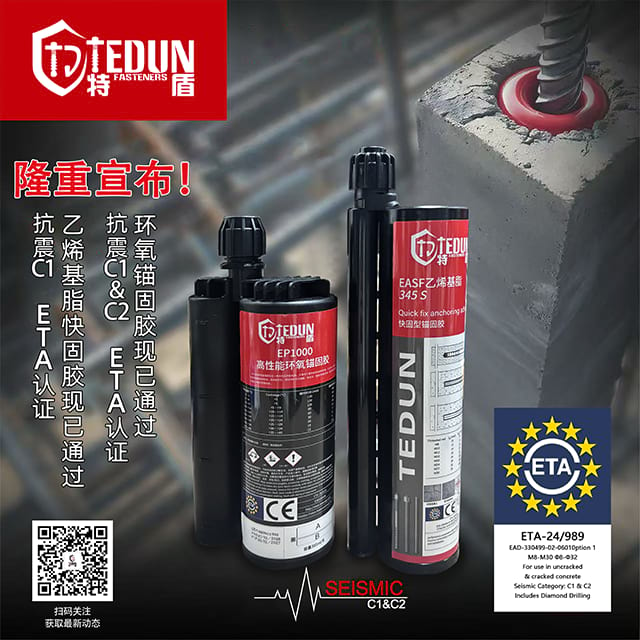
While they require a longer curing time compared to hybrid resins, their ultimate strength is unparalleled. For premium structural applications requiring maximum safety, utilizing a certified pure epoxy chemical anchor like the EP1000 ensures industry-leading reliability. High-end epoxy systems typically feature seismic C1 and C2 approvals, a 50-year design life, and exceptional bond strength even in flooded holes. This makes them the ultimate choice for heavy-duty infrastructure.
Vinylester is a highly versatile and fast-acting hybrid resin. Modern applications almost always utilize styrene-free versions. It cures significantly faster than pure epoxy, making it the go-to adhesive for projects with tight and unforgiving deadlines. It performs exceptionally well in cold weather and damp concrete conditions. Providing a robust solution for medium-to-heavy structural loads, it remains the most common daily choice for fast-paced commercial construction.
Polyester resin is the standard and highly economical choice for non-structural indoor applications. Contractors widely use it for securing medium-weight loads into masonry, hollow bricks, and uncracked concrete. It lacks the extreme load capacity and harsh chemical resistance of epoxy or vinylester. However, it is highly effective and budget-friendly for installing handrails, HVAC equipment, and lightweight bathroom fixtures.
The ultimate load capacity is entirely dependent on meticulous installation. Treat the following steps as a strict standard operating procedure. Deviation from these steps will result in catastrophic structural failure.
Using a heavy-duty rotary hammer drill, create a hole to the exact diameter and depth specified by the technical data sheet. Ensure the carbide drill bit is in good condition. Worn bits create undersized holes that prevent the proper volume of resin from surrounding the threaded rod.
This is the most critical phase of the entire installation process. If concrete dust remains caked inside the hole, the injected resin will bond to the loose dust rather than the solid concrete wall. This acts as a fatal bond breaker. Installers must employ the standard Blow-Brush-Blow method.
First, blow out the loose dust using oil-free compressed air or a manual blow pump. Second, brush the walls vigorously with a stiff steel wire brush sized correctly for the hole diameter. You should feel the aggressive bite of the bristles scraping the concrete. Finally, blow the hole out a second time until absolutely no visible dust emerges.
Attach the static mixing nozzle to the cartridge and place it in the dispenser gun. When you pull the trigger, always dispense the first few pumps onto a piece of scrap cardboard. Wait until the extruded chemical changes to a completely uniform color. This ensures the resin and hardener are properly mixed.
Insert the nozzle all the way to the very bottom of the cleaned hole. Slowly inject the resin while gradually withdrawing the nozzle. Fill the hole approximately two-thirds full. This prevents trapped air pockets and ensures proper thread coverage.
Take your threaded rod or rebar and insert it using a slow deliberate twisting motion. This twisting action helps eliminate any trapped air bubbles and ensures the viscous resin coats the threads evenly. Once seated, wipe away any excess adhesive that extrudes from the surface.
The anchor must now be left completely undisturbed. Adhere strictly to the manufacturer specified curing time before applying any torque with a wrench or attaching a structural load. Curing times fluctuate heavily based on the ambient temperature and resin type.
To guarantee structural integrity, engineers must evaluate several key site factors before specifying a fastening product. Instead of guessing, use these actionable criteria to make the right selection.
Carefully identify the substrate. Are you drilling into cracked or uncracked concrete? Solid brick or a hollow masonry block? Different materials mandate specific resins and installation methods. For example, hollow blocks require mesh sieve sleeves to contain the resin. Smooth diamond-cored holes in dense concrete demand non-shrinking pure epoxy to guarantee a secure grip.
Consider the immediate installation environment alongside long-term exposure. Will the team install the anchor in freezing winter temperatures, a damp basement, or a facility exposed to corrosive industrial chemicals? Fast-curing vinylester works best in freezing temperatures. However, if your project involves submerged conditions or requires maximum structural integrity in harsh chemical environments, specifying a premium chemical anchor epoxy is highly recommended to prevent premature degradation.
For professional commercial applications, always look for products carrying recognized structural certifications. European Technical Assessments or local equivalent approvals like ICC-ES in North America are mandatory for critical loads. These rigid certifications guarantee the product has undergone exhaustive independent testing for seismic performance, fire resistance, and long-term load capacity under extreme stress.
While resin-based systems undeniably require more preparation, specialized equipment, and curing time than traditional expansion bolts, the trade-off is well worth the effort. Their unparalleled load capacity, stress-free application, and incredible versatility make them the superior choice for critical fastening in modern construction.
Ultimately, the success of your connection relies on proper preparation. Always match the specific resin type to your exact load requirements, base material, and environmental conditions. Never cut corners during the hole-cleaning process.
If you are planning a high-stakes structural project and cannot afford to compromise on safety, it is time to upgrade your fastening strategy. Explore high-performance options like the EP1000 Pure Epoxy System from Tedun Fasteners for your next demanding application to ensure rock-solid reliability.
The load capacity depends entirely on the resin type, embedment depth, rod diameter, and the strength of the concrete. Premium pure epoxy systems combined with large-diameter threaded rods can easily hold tens of thousands of pounds in tension. Always consult the manufacturer's technical data sheet for specific load tables based on your exact installation parameters.
Pure epoxy offers the absolute highest strength, zero shrinkage, and superior performance in diamond-cored or flooded holes, but it takes longer to cure. Vinylester is a hybrid resin that cures much faster and performs exceptionally well in cold weather. While slightly lower in ultimate load capacity than epoxy, vinylester is highly versatile and ideal for fast-paced daily construction.
Curing time depends entirely on the specific resin chemistry and the ambient temperature of the base material. Fast-acting vinylester and polyester resins can cure in as little as 30 to 60 minutes in warm summer conditions. Pure epoxy systems cure much slower, often requiring anywhere from 12 to 24 hours to achieve full load-bearing capacity.
Yes, but you must use specific certified formulations. Pure epoxy systems are generally the best and most reliable choice for damp, wet, or fully submerged holes. They displace water effectively without compromising the polymer bond. Some fast-curing vinylester products can also be used in damp conditions, but you must verify the product's technical approval for water-filled applications before proceeding.
No, the resin forms a permanent high-strength polymer bond with the concrete. Once fully cured, it cannot be unscrewed, pried, or pulled out. The only practical ways to remove it are to cut the threaded steel rod flush with the concrete surface using an angle grinder, or to use a heavy-duty diamond core drill to extract the entire cylindrical section of concrete containing the embedded stud.
The shelf life typically ranges from 9 to 18 months, depending on the manufacturer and the specific chemical formulation. Proper storage is absolutely critical. Cartridges must be kept in a cool and dry environment away from direct sunlight and extreme temperature fluctuations. Always check the expiration date printed on the cartridge prior to use.
The number one reason for failure is inadequate hole cleaning. If the mandatory Blow-Brush-Blow method is skipped, fine drilling dust remains caked on the walls of the hole. The injected adhesive will then bond tightly to this loose dust rather than the solid concrete structure. This acts as a bond breaker, leading to a smooth and premature pull-out when tension is applied.