

Views: 0 Author: Site Editor Publish Time: 2026-10-29 Origin: Site


Secure fastening serves as the silent backbone of modern structural engineering. On any active construction site, a single compromised connection can jeopardize an entire load-bearing assembly, initiating a domino effect that threatens structural integrity, site safety, and project finances. When securing structural steel, heavy industrial machinery, or architectural facades, specifiers and site engineers constantly grapple with a foundational dilemma: choosing between an expansion-driven anchor and an adhesive chemical system.
Selecting the ideal mechanical anchor for structural fixing or opting for a chemical resin alternative depends entirely on base material characteristics, load dynamics, edge geometry, and on-site environmental realities. Understanding the mechanical friction and chemical bonds at play ensures installations satisfy demanding engineering codes while keeping project schedules running smoothly.
Mechanical fasteners provide instantaneous load-bearing capabilities, require zero cure time, and offer a cost-effective answer for static shear and tension loads in dense, solid concrete.
Chemical anchoring systems excel within complex substrates, such as cracked concrete, lightweight blockwork, or aged brickwork, delivering stress-free embedment and superior resistance against dynamic or seismic forces.
Mechanical expansion concentrates radial stresses outward into the substrate, demanding strict calculations for edge distances and spacing margins to prevent concrete edge breakout.
Adhesive resins create a continuous, distributed shear bond along the entire embedment depth, enabling anchors to sit close to slab edges without generating outward bursting stress, provided dust cleaning protocols are strictly executed.
Every post-installed anchor relies on load transfer into mineral base materials, yet the physics behind that transfer split into two distinct philosophies. Mechanical anchors rely on direct mechanical resistance. When a technician applies calibrated torque to the nut or bolt head, a hardened expander cone pulls upward into an expansion collar. This action forces the steel sleeve outward against the walls of the drilled hole, generating radial friction and interlock against aggregate pockets.
Chemical anchoring removes expansion forces entirely. The mechanism relies on chemical adhesion and mechanical keying at the micro-level. A two-part thermosetting resin blends through a static mixer nozzle directly into the bore. When the installer threads a threaded rod or rebar dowel into the adhesive, the resin fills microscopic fissures and flute ridges. Once cured, the polymer matrix acts as an unbroken shear bridge that binds the steel anchor and the surrounding aggregate into a single unit.
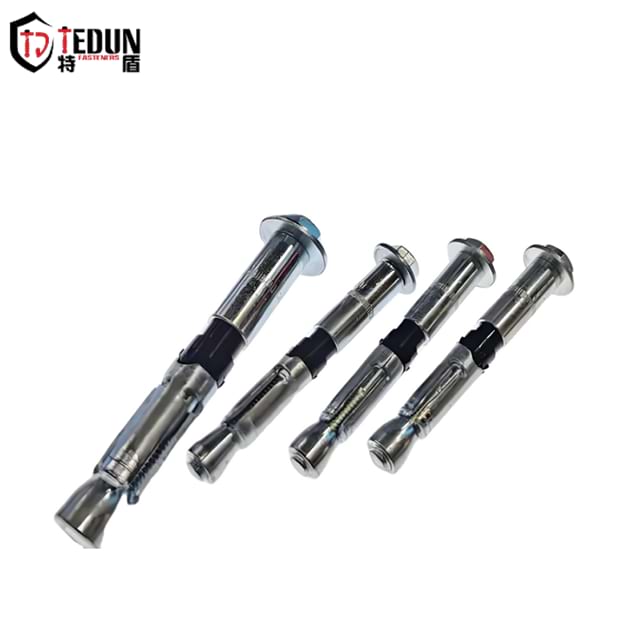
Mechanical anchors remain the default choice for heavy commercial building frames, industrial equipment pads, and secondary structural steel. For contractors racing against crane rental clocks, a certified Heavy-Duty Mechanical Anchor for Structural Fixing provides a major practical benefit: the joint carries full rated design load the moment torque verification is complete.
Industrial mechanical anchors generally utilize high-tensile carbon steel of grade 8.8 or grade 10.9, as well as marine-grade 304 or 316 stainless steel for aggressive conditions. Thread diameters typically range from M8 up to M24 or M30, supporting tensile design loads reaching well past 100 kilonewtons in premium solid concrete foundations. Surface treatments such as thick hot-dip galvanizing or specialized zinc-flake coatings protect against rust without degrading thread engagement.
Wedge Anchors: Designed strictly for solid concrete. The solid steel body features an integrated expansion clip that grips the hole wall as torque pulls the bottom mandrel upward. They provide exceptional pullout values in high-strength uncracked slabs.
Heavy-Duty Sleeve Anchors: Built with a full-length collapsible sleeve that compresses axially during tightening. This spreads radial forces across a broader area, making them reliable in solid masonry and precast floor units.
Drop-in Anchors: Female threaded sleeves installed flush with the surface, activated by driving an internal plug with a dedicated punch. They are ideal for suspended utility trays, HVAC trunking, and pipe brackets.
Undercut Anchors: Engineered for critical structural joints and safety zones. A dedicated undercutting bit flares out a pocket at the base of the bore, creating a positive mechanical interlock that holds firmly even when concrete cracks open during seismic shifts.
Field speed is the decisive factor. Installers drill, blow out loose aggregate, drive the anchor with a mallet, and apply specified torque. The work requires no special temperature-controlled storage, no disposal of empty chemical containers, and no waiting for resins to cure. Whether operating in sub-zero winter temperatures or intense desert heat, the physical expansion mechanism functions consistently.
Because these fasteners exert concentrated lateral burst pressure, they require substantial edge distances and spacing margins. If an installer sets an expansion anchor too close to a slab boundary, the wedging forces will split the concrete along the perimeter. Standard mechanical expansion designs also experience holding capacity drops in tension zones where hairline cracks open through the anchor embedment depth.
Adhesive fixing systems handle structural scenarios where concrete geometry or variable substrates rule out mechanical expansion. By distributing shear resistance along the complete embedded surface, the chemical resin prevents severe stress concentration.
Field performance depends directly on the polymer formulation chosen for the project:
Pure Epoxy Systems: Formulated with near-zero volumetric shrinkage and high bond strength, pure epoxy represents the standard for heavy civil infrastructure, diamond-cored holes, and structural rebar post-installation. However, epoxies cure slowly, typically taking anywhere from 4 to 24 hours depending on ambient warmth.
Vinylester Hybrid Systems: Offering an optimal balance of structural strength and rapid setting, vinylester resins cure within 30 to 60 minutes. They resist moisture intrusion and perform reliably in wet boreholes.
Polyester Resins: Quick-setting and budget-friendly, polyester suits masonry tie-ins, facade brackets, and light-to-medium fixings where design loads remain modest.
The total absence of expansion stress is a major advantage. Structural engineers can place chemical anchors remarkably close to free slab edges, narrow curbs, and slim precast columns without causing spalling. When working in cracked concrete, high-grade hybrid formulations bond effectively across micro-fractures. In addition, the hardened polymer forms an airtight, watertight barrier that protects embedded steel against groundwater ingress, deicing salts, and chemical spills.
Site discipline dictates the success of every chemical fixing. Residual dust left on bore surfaces acts as a debonding agent, cutting load capacity by up to 60 percent. Installers must follow a strict blow-brush-blow cleaning cycle using oil-free compressed air and stiff steel brushes. Curing schedules can also delay multi-trade workflows in freezing weather, and unused cartridges carry finite shelf lives of 12 to 18 months.
Selecting the right fastening system requires a balanced assessment of mechanical demands, structural geometry, and daily site realities:
Design Parameter | Chemical Adhesive Anchor | Mechanical Expansion Anchor |
|---|---|---|
Load Mechanism | Continuous shear bond across total borehole length | Point-concentrated friction and outward radial burst |
Immediate Loading | No; requires cure window ranging from minutes to hours | Yes; instantaneous full load capacity upon torquing |
Edge Distance Limits | Very low; suitable for edge-critical structural slabs | High; requires significant edge margins to avoid blowout |
Substrate Compatibility | Universal; solid concrete, hollow block, porous stone | Specific; solid structural concrete and hard stone only |
Vibration Damping | Excellent; polymer cushions dynamic machinery shocks | Moderate; harmonic cyclic vibrations can loosen friction |
Installation Sensitivity | High; demands thorough dust extraction and dry holes | Low to moderate; tolerant of minor cleaning oversights |
Material Shelf Life | Sensitive; chemical cartridges expire after 12 to 18 months | Indefinite; metallic fasteners never degrade on site racks |
Rather than treating anchor choice as a matter of habit, field supervisors and specifiers can match project parameters to these clear operational criteria.
A high-performance mechanical anchor for structural fixing is the preferred solution under these jobsite conditions:
Structural Steel Column Bases: When erecting portal frames or warehouse columns, crane hoists tie up project capital. Mechanical anchors secure baseplates instantly, allowing riggers to disconnect lifting gear without waiting for resins to set.
Large-Scale Logistics and Racking Systems: Warehouse facilities require thousands of baseplate fixings across broad concrete floors. Drilling, tapping, and torquing mechanical wedge anchors saves hundreds of labor hours compared to two-part cartridge dispensing.
Cold-Climate Construction: When site temperatures drop below freezing, adhesive curing halts entirely unless heated enclosures are deployed. Carbon and stainless mechanical anchors install normally regardless of temperature.
Overhead MEP Infrastructure: Fastening suspended cable trays, ductwork, and fire piping overhead with drop-in anchors eliminates the risk of uncured resin dripping down onto technicians and access machinery.
Conversely, shift directly to a chemical anchoring system under these structural conditions:
Perimeter Balustrades and Bridge Barriers: Fastening posts within 50 millimeters of an exterior slab boundary will crack concrete under mechanical wedge pressure. Adhesive resin safely secures the steel stud right up to the edge.
Heavy Vibratory Plant: Industrial reciprocating pumps, punch presses, and vibratory screens generate harmonic stress that can rattle mechanical wedges loose over time. The viscoelastic nature of synthetic resins absorbs these cyclic micro-shocks.
Structural Rebar Extensions: Splicing new floor slabs into existing load-bearing columns requires deep embedment depths. Pure epoxy injection around deformed rebar matches cast-in-place development length standards precisely.
Porous, Aged, or Hollow Masonry: In historic brick restoration or hollow cinder block framing, mechanical expansion will crush the internal web. A chemical resin paired with a perforated mesh sleeve forms an interlocking anchor bulb that locks into masonry cavities safely.
The post-installed anchoring industry is undergoing fundamental shifts driven by stricter seismic mandates, enhanced environmental rules, and stricter building safety codes. Structural designs in active seismic regions now widely require certification under European ETA C1 and C2 standards or international ICC-ES acceptance criteria. Both mechanical and chemical solutions must prove their holding reliability as foundation cracks open and close under cyclic seismic action.
At the same time, installer error remains the leading cause of anchor failures on site. To address this risk, modern jobsites increasingly mandate hollow suction drill bits connected directly to certified dust-extraction vacuums. This approach creates an automated, dust-free borehole while drilling, eliminating manual wire-brushing steps and cutting installer exposure to hazardous respirable crystalline silica.
Chemical resin manufacturers have largely transitioned away from older formulations containing volatile organic compounds toward styrene-free, clean-air certified adhesives. Meanwhile, high-grade mechanical anchors are adopting advanced multi-layer zinc-flake coatings, matching the corrosion resistance of chemical anchors in humid or coastal settings while delivering instant torque verification on site.
Neither system holds an absolute advantage across every scenario. Mechanical fasteners offer outstanding speed, cost control, and instant structural support in dense concrete. Chemical systems provide unmatched engineering flexibility, vibration resistance, and edge security across complex geometries and challenging substrates.
For high-demand industrial installations, evaluate your substrate quality, spacing limits, and project timelines carefully before ordering hardware. Explore the comprehensive range of precision structural fasteners from Tedun Fasteners to match your load calculations with tested, heavy-duty mechanical anchors that keep your site compliant, secure, and on schedule.
Chemical anchors generally achieve higher ultimate tensile capacities in laboratory pullout tests. Because the resin adheres across the entire borehole depth, failure typically occurs when the surrounding concrete cone shears out, rather than through adhesive slip. However, heavy-duty undercut mechanical anchors achieve comparable performance ratings in high-strength solid concrete.
Standard wedge anchors should not be installed in brickwork because their concentrated outward expansion will fracture the brittle masonry. Moderate-duty sleeve anchors may work inside solid engineering bricks, but chemical resin paired with a perforated sleeve is the safest and most durable solution for historic or hollow brick masonry.
Concrete dust creates an unbonded barrier between the synthetic resin and the solid aggregate wall of the borehole. Leaving dust inside the hole can reduce ultimate tensile capacity by more than half, potentially causing anchor slippage far below design loads. Always follow the engineer-specified blow-brush-blow cleaning procedure.
Yes, chemical anchor cartridges carry an expiration date, typically between 12 and 18 months from the manufacturing date. Over time, internal reactive hardeners degrade, which can lead to incomplete curing or a permanent loss of structural capacity. Metallic mechanical anchors, in comparison, have an indefinite shelf life.
No, chemical anchors are permanent installations. Once the resin cures, the threaded stud or rebar becomes permanently bonded into the substrate. If a fixture must be relocated, the exposed steel rod must be cut off flush with the concrete surface. By contrast, certain mechanical fasteners, such as heavy-duty concrete screws and removable sleeve anchors, can be unbolted and backed out cleanly.
Mechanical expansion anchors usually demand an edge distance equal to at least 8 to 10 times the anchor diameter to prevent outward radial bursting of the concrete edge. Chemical adhesive anchors do not exert radial expansion pressure during installation, allowing engineers to reduce edge distances down to 3 to 5 times the anchor diameter, subject to local structural design codes.